The Playlists administration agenda is the tool for managing playlists on the portal — we find all the playlists we have access to there, and from there we get to editing them. We open it from the menu with Content administration → Playlists.
A playlist is a specific type of media on the portal. It has its own descriptive data and preview image, and it is subject to search and sorting. On the media playback page, however, it is represented only by a navigation panel, and within the context of the player the user gradually watches all the media files the playlist contains. On the page, the move to the next media file happens automatically once the end of the previous media is reached.
The playlist listing
Which records we see depends on the role of the logged-in user:
- An editor manages their own playlists and playlists from shared folders
- A redactor additionally the playlists of their team of editors
- An administrator all playlists on the portal
Above the table we have the My media / All media switch and next to it a search field where we choose which value is searched. The arrow button  on the right expands further filters (folder, status, protection, editor and the criteria set up by the portal administrator); the Reset button returns the filters to their default state. Above the table on the right there is then the sorting switch.
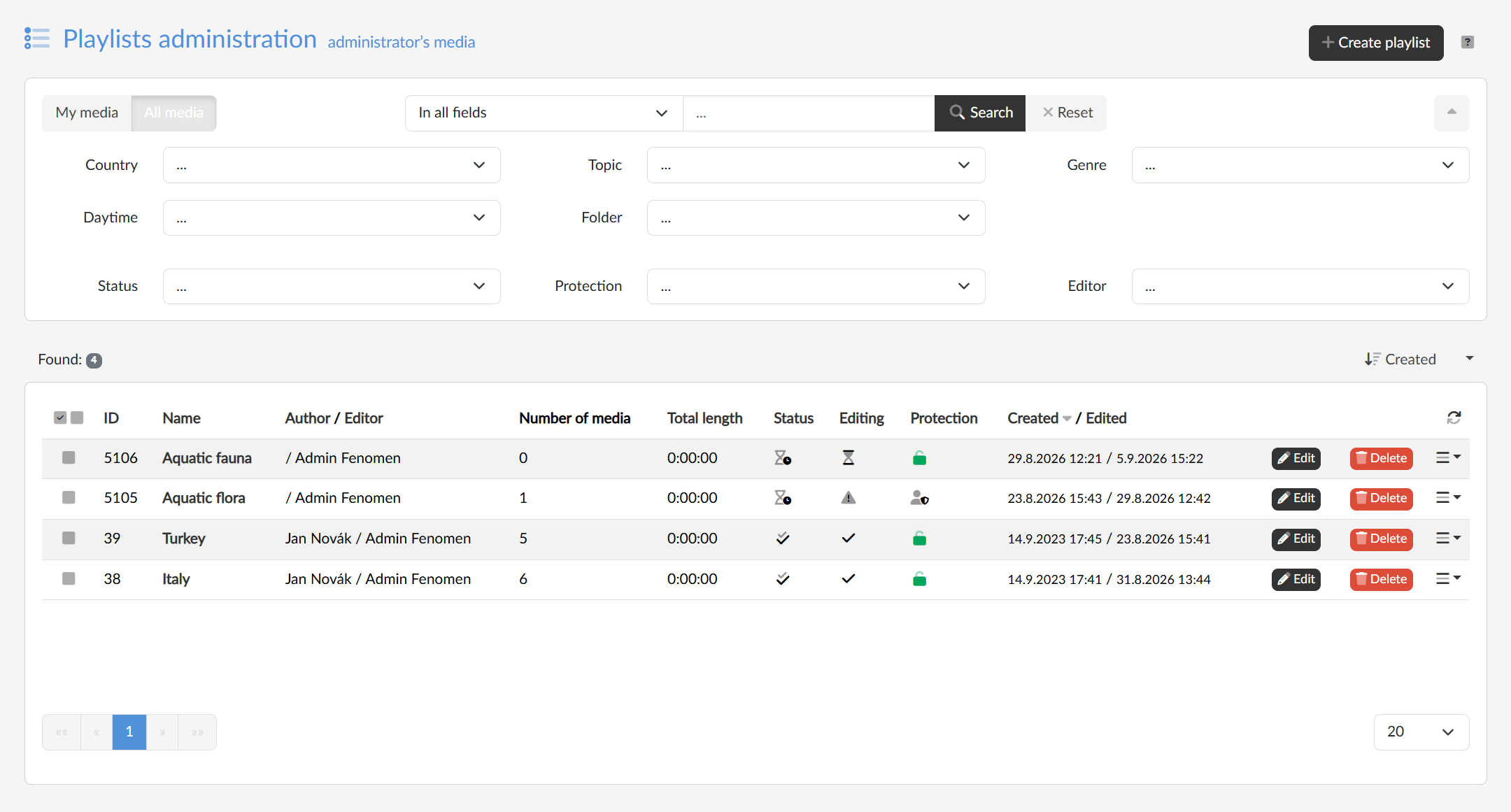
The icon in the Status column indicates, analogously to an ordinary video/audio media file, whether the playlist is “ready for playback”  or is being processed
  — it is waiting for at least one media ready for playback to be added to the playlist content, and it evaluates whether all the mandatory
  descriptive data have been filled in — for a playlist, that means the description and the mandatory sorting. Hovering over the icons displays what each of them means exactly.
The playlist is edited on its detail pages, which we open with the Edit button or by clicking the name of the playlist; the listing itself offers the Delete button, and under the menu icon  there are
- the operation for changing the editor of the playlist,
- changing the folder,
- and a tool for moving the playlist between portals.
The first column of the table also offers a checkbox that includes the record in the row among the bulk actions, where it is possible to do the following for several playlists at once
- change the protection level,
- change the editor,
- change the folder,
- move the playlists to another portal,
- and apply a descriptive data template.
The bulk actions menu appears as soon as we select the first record; next to it we see the number of playlists found and the number selected, and the Show only selected items checkbox limits the listing to them.
Setting up a new playlist
We set up a new playlist with the Create playlist button in the top right. The dialog box for setting up a new playlist requires just one piece of information, the name. The portal creates the playlist and takes us straight to its detail, to the Overview tab; from there we need to fill in both the content on the Playlist content tab and the Descriptive data.